Construction is one of the most complex industries in the world. Behind every completed structure — whether a hospital, a highway, or a high-rise apartment — lies a web of decisions, materials, timelines, and teams that must work in precise coordination.

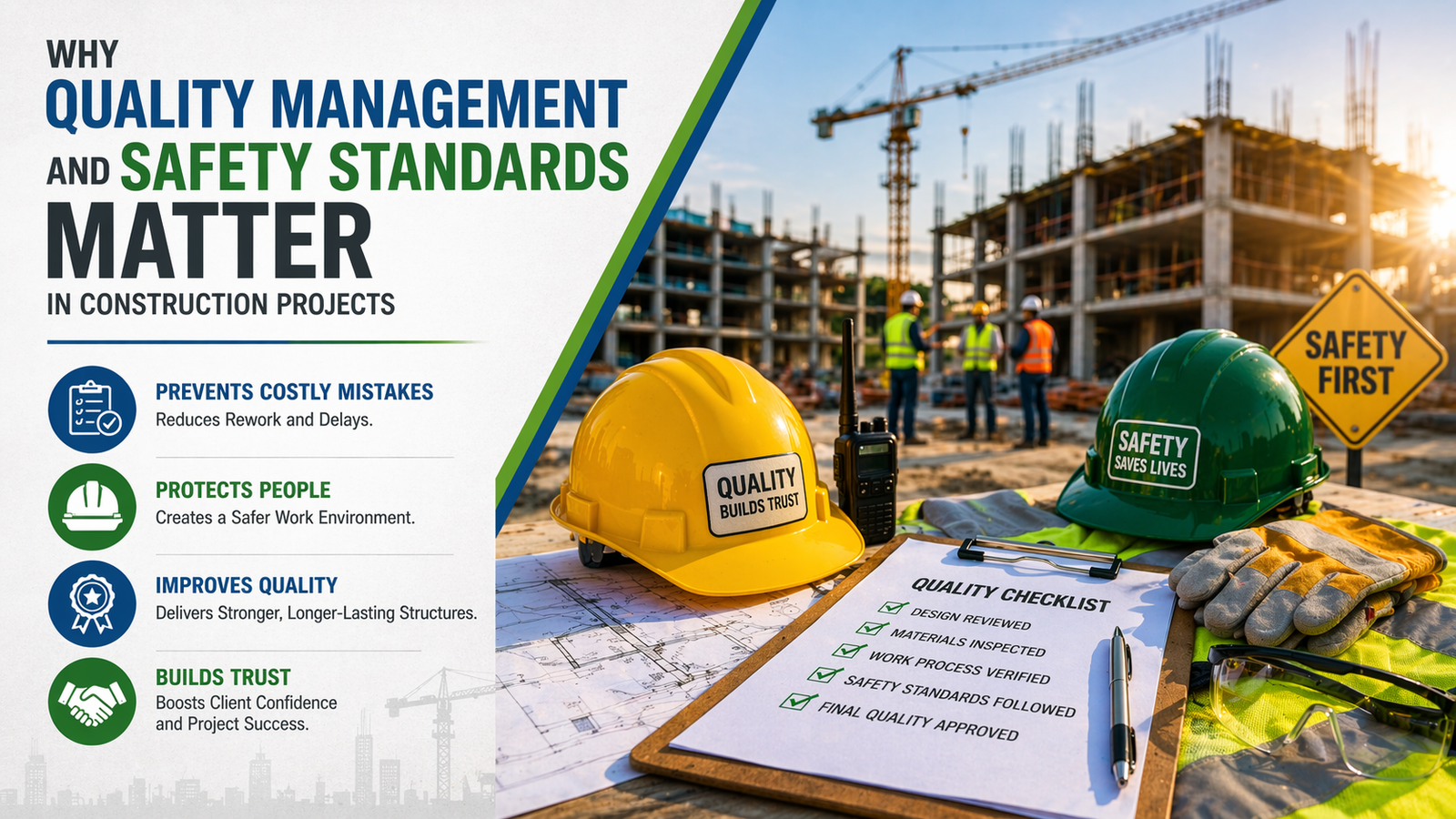
Quality management in construction is not a luxury or a bureaucratic checkbox. It is the backbone of every project that finishes on time, within budget, and without putting lives at risk. From the initial design phase to the final handover, quality and safety are not separate concerns — they are deeply intertwined elements of responsible construction practice.

This article explains quality management in construction, the role of safety standards, why QA/QC matters, and how site compliance ensures project success.

What Is Quality Management in Construction?

Quality management in construction refers to the systematic approach of planning, executing, monitoring, and improving the processes that determine whether a project meets defined standards. It encompasses everything from the selection of raw materials to the final inspection of installed systems.

At its core, quality management in construction is built on four pillars:

1. Quality Planning Before a single brick is laid, quality planning establishes the benchmarks a project must meet. This includes selecting appropriate materials, defining workmanship standards, aligning with local building codes, and setting up documentation protocols. Planning at this stage prevents costly surprises later.

2. Quality Assurance (QA) Quality assurance in construction is proactive. It involves designing and implementing processes that make defects unlikely in the first place. QA activities include contractor prequalification, staff training, procedure audits, and regular design reviews. The goal is to build quality into the process, not just inspect for it at the end.

3. Quality Control (QC) Where QA is about prevention, quality control is about detection. QC teams carry out inspections, material testing, and measurements throughout the project lifecycle to catch non-conformances before they become embedded problems. Concrete strength tests, weld inspections, and dimensional checks are all classic QC activities.

4. Continuous Improvement The best construction organisations use lessons learned from one project to sharpen their processes on the next. Root cause analysis of defects, post-project reviews, and benchmarking against industry standards all feed into a cycle of ongoing improvement.

Together, these four pillars make quality management in construction a living system — not a document filed away and forgotten.

Why Construction Safety Standards Cannot Be Compromised

Every year, thousands of construction workers suffer serious injuries or fatalities globally. Falls from height, electrocution, being struck by moving objects, and being caught in machinery are among the most common causes. Construction safety standards exist to prevent these tragedies and create environments where workers return home safely every day.

Construction safety standards are typically established at multiple levels:

  • National and regional legislation sets the legal minimum requirements. In India, for instance, the Building and Other Construction Workers Act outlines employer responsibilities. In the UK, the Construction (Design and Management) Regulations place legal duties on clients, designers, and contractors alike.
  • International standards such as ISO 45001 (Occupational Health and Safety Management Systems) provide globally recognised frameworks for managing workplace safety.
  • Industry codes of practice issued by professional bodies add sector-specific guidance on issues like scaffolding, trenching, and electrical work.
  • Project-specific safety plans translate these broader requirements into site-level procedures, emergency protocols, and daily toolbox talks.

The importance of construction safety standards goes beyond protecting individuals. A single serious incident can halt an entire project, trigger regulatory investigations, damage a contractor’s reputation permanently, and expose the project owner to significant legal liability. The financial cost of poor safety culture is almost always greater than the cost of implementing robust safety systems from the start.

Understanding QA QC in Construction: A Practical Breakdown

Many people use QA and QC interchangeably, but they represent distinct and complementary functions within the broader framework of quality management in construction.

QA in Construction: Building the Right Systems

Quality assurance focuses on the systems, procedures, and culture that make consistent quality achievable. A strong QA programme in construction might include:

  • Documented inspection and test plans (ITPs) that specify what needs to be checked, how, by whom, and when
  • Material approval processes ensuring only specified, tested materials are used
  • Subcontractor management systems that verify third-party work meets project requirements
  • Regular internal audits comparing actual practice against documented procedures
  • Non-conformance report (NCR) management systems that track defects and their resolution

The hallmark of good QA is that it creates predictability.

QC in Construction: Verifying the Work

Quality control is the hands-on verification layer. QC engineers and inspectors are present on site, physically checking work against approved drawings, specifications, and standards. Common QC activities include:

  • Concrete cube testing to verify compressive strength
  • Rebar inspection before concrete is poured
  • Weld visual inspection and non-destructive testing (NDT)
  • Dimensional surveys of completed structures
  • Waterproofing integrity testing
  • Fire protection system checks
  • Final snagging and commissioning inspections

Site Compliance: Connecting Standards to Ground-Level Reality

Understanding what site compliance means in a construction context is essential for any professional who works on or manages a construction project. Site compliance is the practical application of legal, contractual, and technical requirements at the project level. It bridges the gap between policy documents written in offices and the realities of a busy, often unpredictable construction site.

Site compliance covers several interconnected areas:

Regulatory Compliance Construction projects must adhere to local planning permissions, environmental regulations, building codes, and health and safety legislation. Failure to comply exposes the contractor and client to enforcement action, including stop-work orders, fines, and in serious cases, criminal prosecution.

Contractual Compliance Beyond legal requirements, construction contracts specify technical standards, testing frequencies, documentation requirements, and approval workflows. Site compliance means meeting these contractual obligations consistently and demonstrating compliance through auditable records.

Environmental Compliance Modern construction projects are increasingly subject to environmental management requirements — covering dust suppression, noise levels, waste disposal, water runoff, and protection of nearby habitats. Environmental non-compliance can result in significant fines and reputational damage.

Documentation and Record Keeping Compliance without documentation is invisible. Site compliance programmes depend on well-maintained records: inspection reports, test certificates, material delivery tickets, non-conformance reports, and corrective action records. These documents protect all parties in the event of disputes and are essential for project handover.

A robust site compliance programme does not happen accidentally. It requires a dedicated compliance function, clear accountability, regular site audits, and a culture where workers at every level understand why these requirements exist and feel empowered to raise concerns.

Project Quality Control: Managing Quality Across the Entire Lifecycle

While QC inspections are important, project quality control is a broader concept that spans the entire lifecycle of a construction project — from feasibility and design through construction and into handover and operations.

Pre-Construction Phase Project quality control begins before work starts on site. Design reviews check that drawings and specifications are complete, coordinated, and buildable. Constructability reviews identify potential problems before they become expensive changes. Value engineering sessions look for opportunities to achieve the required quality at optimal cost. Procurement quality processes ensure that materials and equipment suppliers can genuinely deliver to specification.

Construction Phase During construction, project quality control involves:

  • Continuous monitoring of work against the approved quality plan
  • Hold points and witness points built into the inspection and test plan
  • Regular progress meetings where quality performance is formally reviewed alongside schedule and cost
  • Proactive management of non-conformances — ensuring they are addressed promptly and the root cause is understood
  • Coordination of third-party inspections where required by contract or regulation

Handover and Commissioning Phase Project quality control reaches its culmination at handover. A thorough commissioning programme verifies that all systems — structural, mechanical, electrical, plumbing, and fire protection — perform as designed. Snagging lists are created, tracked, and closed out. As-built drawings and operation and maintenance manuals are compiled and handed to the client. Only when all quality requirements are demonstrably met should practical completion be granted.

The Business Case: Why Quality and Safety Pay for Themselves

Some project stakeholders still view quality management in construction and construction safety standards as cost centres — overheads that eat into margins.

Consider the cost of rework. Industry research consistently shows that rework in construction typically accounts for between 5% and 15% of total project cost. A robust QA QC in construction programme that catches problems early, before work is buried or covered up, can eliminate the vast majority of this rework. The savings far outweigh the cost of the quality programme itself.

Consider the cost of incidents. A serious accident on site triggers investigation, potential project shutdown, legal fees, insurance claims, and damage to the contractor’s ability to win future work. The indirect costs — including the human cost to workers and their families — are incalculable.

Consider the cost of defects at handover. Latent defects discovered after practical completion can trigger expensive warranty claims, damage client relationships, and in extreme cases, result in litigation that ties up resources for years.

Against these risks, investment in quality management in construction and construction safety standards is not a cost — it is insurance. And unlike most insurance, it actively reduces the likelihood of the events it protects against.

Emerging Trends Shaping Quality and Safety in Construction

The construction industry is evolving rapidly, and the tools available for quality management and safety are evolving with it.

Building Information Modelling (BIM) enables quality issues to be identified and resolved in the digital model before they appear on site. Clash detection, design coordination, and quantity verification all contribute to better quality outcomes.

Digital inspection platforms replace paper-based QC processes with mobile apps that capture inspection results, photos, and signatures in real time. . Data analytics identify recurring quality issues and enable targeted interventions.

Wearable safety technology — including smart helmets, proximity sensors, and gas detection devices — provides real-time monitoring of site conditions and worker wellbeing, taking construction safety standards into a new dimension.

Drone surveys enable rapid, accurate inspection of areas that are difficult or dangerous to access physically, improving both quality and safety outcomes.

These technologies do not replace the fundamentals of quality management in construction. They amplify them, making it easier than ever to achieve consistent, demonstrable quality and safety performance.

 Quality and Safety Are Not Optional — They Are Non-Negotiable

The construction industry shapes the physical world in which people live, work, and move. The buildings we construct become homes, schools, hospitals, and places of work. The infrastructure we build carries people, water, power, and data. The stakes could not be higher.

Investing in QA QC in construction processes, maintaining rigorous site compliance, and applying disciplined project quality control throughout the project lifecycle are not costs to be minimised.

For construction professionals at every level, the message is clear. Make quality and safety the first conversation on every project, not the last. The structures you build will stand for generations. Build them as if they matter — because they do.

Frequently Asked Questions 

 1: What is the difference between quality assurance and quality control in construction?

Quality assurance (QA) in construction refers to the systematic processes and procedures put in place to prevent defects from occurring. It is proactive and process-focused. Quality control (QC), on the other hand, is the reactive, inspection-based activity of checking completed work to verify it meets specified standards.

2: Why is quality management important in construction projects?

Quality management in construction is critical because it directly impacts the safety, durability, and functionality of the built structure. Poor quality leads to costly rework, structural defects, client dissatisfaction, and in worst cases, structural failure that endangers lives. A strong quality management system reduces rework costs, minimises delays, protects the contractor’s reputation, and ensures that the final product performs as intended for its full design life.

 3: What are the main construction safety standards that apply to projects?

Key construction safety standards vary by country but generally include national health and safety legislation (such as OSHA standards in the US or CDM Regulations in the UK), international standards like ISO 45001 for occupational health and safety management, industry codes of practice for specific activities such as scaffolding and excavation, and project-specific safety plans. Site compliance with all applicable standards is a legal and contractual obligation for contractors and project owners.

 4: How does project quality control differ from QA QC in construction?

Project quality control is a broader, lifecycle-spanning concept that encompasses the full range of quality management activities from design through handover. QA QC in construction refers specifically to the quality assurance and quality control functions that are part of this broader system. QA QC represents the “how” of quality verification and assurance, while project quality control is the overall management framework within which those activities sit alongside planning, risk management, and continuous improvement.

 5: How can technology improve quality management and safety in construction?

Technology is transforming quality management and construction safety standards in multiple ways. Building Information Modelling (BIM) enables early identification and resolution of design clashes before they reach site. Digital inspection platforms allow real-time capture and tracking of quality data, reducing reliance on paper-based systems. Drone surveys enable safe inspection of difficult-to-access areas.